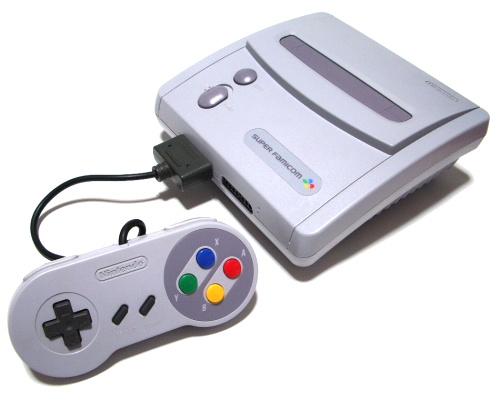
Super Nintendo Entertainment System
16-bit Nintendo console with Mode 7 graphics and iconic 6-button controller.
Overview
The **Super Nintendo Entertainment System (SNES)**, known as the Super Famicom in Japan, is a 16-bit home video game console released by Nintendo in 1990 (JP), 1991 (NA), and 1992 (EU). It succeeded the NES and entered a highly competitive era against the Sega Mega Drive/Genesis. The SNES is built around a Ricoh 5A22 CPU derived from the 16‑bit 65C816 core, running at variable clock speeds between ~1.79 and 3.58 MHz depending on video mode and bus access. It pairs this with a flexible Picture Processing Unit composed of the S-PPU1 and S-PPU2 chips, which support multiple background modes, hardware scrolling, sprite scaling, and the famous **Mode 7** affine transformation for pseudo‑3D effects used in titles like *Super Mario Kart* and *F‑Zero*. Graphically, the system outputs a native resolution of 256×224 pixels (commonly) up to 512×448 in high‑resolution interlaced modes, with a 15‑bit RGB color space allowing 32,768 possible colors and up to 256 colors on screen at once. It supports up to 128 hardware sprites with per‑scanline limits to balance performance and display integrity. Audio is handled by a dedicated **Sony S-SMP** sound subsystem: an 8‑bit SPC700 controller with a 16‑bit DSP, 64 KB of dedicated audio RAM, and support for 8 simultaneous PCM channels with ADPCM sample compression. This architecture enabled rich, sample‑based soundtracks and complex effects, becoming a hallmark of the SNES generation. The console uses ROM cartridges, often containing enhancement co‑processors such as the **Super FX**, **SA-1**, **DSP** series, and others, extending capabilities for 3D rendering, decompression, and faster logic. This modular approach gave the platform a long competitive life span and allowed technically ambitious games like *Star Fox* and *Yoshi’s Island*. The SNES has a distinctive 6‑button gamepad featuring a diamond‑layout face button cluster, rounded ergonomics, and shoulder buttons—an influential design that shaped virtually all modern console controllers. With an extensive software library including *The Legend of Zelda: A Link to the Past*, *Super Metroid*, *Final Fantasy VI*, and *Chrono Trigger*, the SNES is widely regarded as one of the most important and beloved consoles in gaming history.
Tech Specs
From `platforms.techSpecs`
- audio
- Sony S-SMP sound module: SPC700 8-bit CPU @ ~1.024 MHz + 16-bit DSP, 64 KB audio RAM, 8-channel PCM (ADPCM-compressed samples), up to 32 kHz playback, stereo output.
- cpu
- Ricoh 5A22 (based on 16-bit 65C816 core), variable clock ~1.79–3.58 MHz depending on video/bus state; includes DMA/HDMA, multiplication/division assist.
- gpu
- Nintendo S-PPU1 + S-PPU2 Picture Processing Units; up to 256×224 (common) to 512×448 (hi-res/interlace); 32,768-color palette, up to 256 colors on screen; up to 128 sprites (32 per line), multiple BG modes including Mode 7 affine transform.
- media
- ROM cartridges (commonly 0.5–4 MByte, up to 48 Mbit+), optional enhancement co-processors (Super FX, SA-1, DSP series, etc.).
- ram
- 128 KB main WRAM; 64 KB dedicated audio RAM on SPC700; plus cartridge expansion RAM where present.
- releaseYear
- 1990 (JP), 1991 (NA), 1992 (EU)
- resolution
- Typically 256×224 or 256×239 @ ~60 Hz (NTSC); 256×240 or 288×224/239 @ ~50 Hz (PAL); hi-res modes up to 512×448/478 (interlaced).
Default Controls
From `platforms.defaultControls`
- D-Pad / Move ↑ / ↓ / ← / →
- A Button Z
- B Button X
- X Button A
- Y Button S
- L Shoulder Q
- R Shoulder W
- Start Enter
- Select Shift